LETRS Unit 1 Session 5 Check For Understanding
LETRS Unit 1 Session 5 explores how language comprehension and word recognition work together to create skilled reading. This session helps educators understand how students move from decoding words to making meaning from text, emphasizing the critical connection between vocabulary, background knowledge, and fluent reading.
LETRS Unit 1 Session 5 Assessment
QUESTION:
Reads whole words with phoneme-grapheme mapping.
ANSWER:
Full Alphabetic.
QUESTION:
Recognizes some words using visual features.
ANSWER:
Prealphabetic.
QUESTION:
Remembers multisyllabic words; analogizes easily
ANSWER:
Consolidated Alphabetic.
QUESTION:
Knows a few phoneme-grapheme correspondences
ANSWER:
Partial Alphabetic.
QUESTION:
This student was asked to write about a favorite celebration with family or friends. She wrote: My favorite celebration Halloween. We go trick or treating. It is fun because you get lots of candy and we get to wear costumes and we get wear costumes to school and we get to show our costumes to friends.
Which of Ehri’s phases does this sample represent?
ANSWER:
Full Alphabetic.
QUESTION:
This student attempted to write a story about mowing the lawn.
Which of Ehri’s phases does this sample represent?
ANSWER:
Prealphabetic.
QUESTION:
This student was asked to write about his favorite season.
Which of Ehri’s phases does this sample represent?
ANSWER:
Consolidated Alphabetic.
QUESTION:
This student was asked to write the following words: fan, pet, dig, rob, hope, wait, gum, sled, stick, shine, dream, blade, coach, fright, and snowing.
Which of Ehri’s phases does this sample represent?
ANSWER:
Partial Alphabetic.
QUESTION:
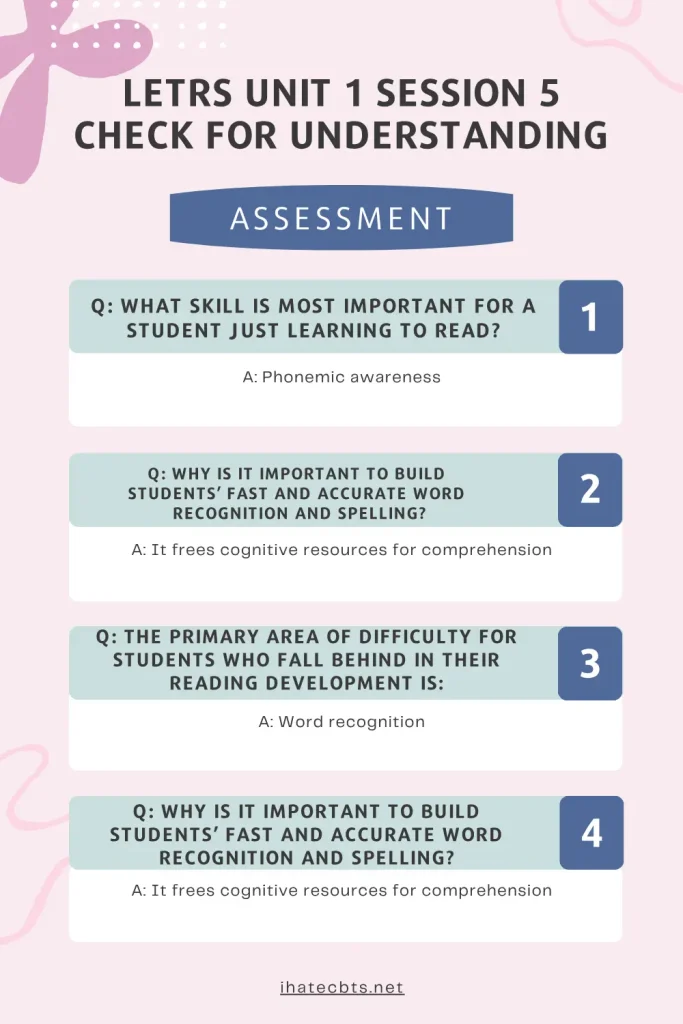
What skill is most important for a student just learning to read?
ANSWER:
accurate decoding.
EXPLANATION:
1. What skill is most important for a student just learning to read?
Accurate Decoding
Accurate decoding is the foundational skill that students must develop when they first learn to read. Decoding refers to the ability to translate written words into spoken language by recognizing the letters and their corresponding sounds (phonemes). This process involves several key components:
- Phonemic Awareness: Before students can decode, they need to understand that words are made up of individual sounds. This awareness is crucial because it allows them to break down words into manageable parts.
- Phonics: This involves the relationship between letters (graphemes) and sounds (phonemes). When students learn phonics, they can apply this knowledge to decode unfamiliar words. For example, knowing that the letter “c” typically represents the /k/ sound helps a student read the word “cat.”
- Fluency: While not the sole focus in the beginning stages, fluency—the ability to read with speed and accuracy—develops alongside decoding. As students practice decoding, they become more fluent, which in turn enhances their overall reading comprehension.
Accurate decoding is crucial because it serves as a bridge to understanding the meaning of text. If a student struggles with decoding, it can hinder their ability to comprehend what they are reading, leading to frustration and a lack of motivation. Therefore, teaching students to decode accurately is essential for fostering a positive reading experience and promoting literacy skills that will benefit them throughout their education.
QUESTION:
Why is it important to build students’ fast and accurate word recognition and spelling?
ANSWER:
so that students don’t have to laboriously sound out words.
EXPLANATION:
Why is it important to build students’ fast and accurate word recognition and spelling?
Fast and accurate word recognition, along with strong spelling skills, are essential for students because they directly contribute to reading fluency and overall comprehension. Here’s why:
- Cognitive Load: When students are able to quickly recognize words, they free up cognitive resources to focus on understanding the meaning of the text rather than laboring over individual words. If a student has to sound out every word, they use more mental energy on decoding rather than comprehension, which can slow down their reading and hinder their ability to grasp the broader message or concepts.
- Automaticity in Reading: Automaticity refers to the ability to recognize words without conscious effort. This is crucial because skilled readers can instantly recognize common words or words they’ve encountered before, allowing them to read fluidly and focus on higher-order thinking skills like inference, critical analysis, and interpretation. The quicker a student can recognize words, the more seamlessly they can understand and enjoy reading.
- Fluency and Comprehension: Fast and accurate word recognition directly contributes to reading fluency. Fluency is not just about reading quickly, but also with appropriate expression and understanding. Fluent readers can read aloud with ease, accurately interpret punctuation and tone, and better comprehend what they are reading. Without fluency, students may struggle with comprehension, as they spend too much time decoding words and lose track of the content.
- Spelling as a Reinforcement of Reading Skills: Good spelling supports reading development. When students learn to spell words accurately, they reinforce their understanding of phonics and word structures. Spelling helps students internalize word patterns and rules, which improves their ability to recognize these words when reading. Additionally, accurate spelling enables students to express themselves more clearly in writing, further strengthening their literacy skills.
In sum, developing fast and accurate word recognition and spelling ensures that students can read efficiently, making the reading process more enjoyable and less labor-intensive, which is key to fostering lifelong reading habits.
QUESTION:
Which scenario describes a child in the prealphabetic phase?
ANSWER:
a child who responds “Meow!” when asked, “What is the first sound in cat?”.
EXPLANATION:
Yes, a child who responds “Meow!” when asked, “What is the first sound in cat?” is likely in the prealphabetic phase of reading development.
The prealphabetic phase is characterized by a lack of understanding of the alphabetic principle, meaning that children do not yet grasp the connection between letters and sounds. Instead of recognizing or identifying individual letters or sounds, they rely on visual or context-based cues. For example, a child may associate the word “cat” with a cat’s meow or other characteristics of a cat rather than understanding that the word is made up of specific sounds (/k/ /a/ /t/) represented by letters.
In this case, the child’s response of “Meow!” shows they are relying on their conceptual understanding of what a cat is (a pet that makes a “meow” sound) rather than decoding the word phonetically. They are associating the word with an image or sound related to the cat, but they are not yet using letters and sounds to understand the word.
In later phases, such as the partial alphabetic or full alphabetic phases, children begin to recognize that specific letters correspond to sounds and can start to sound out words.
QUESTION:
Which scenario describes a child in the consolidated alphabetic phase?
ANSWER:
a child who sees the word inactive and figures out that it means “not active”.
EXPLANATION:
In the consolidated alphabetic phase, children begin to recognize and use larger chunks of letters or letter patterns, such as syllables, prefixes, suffixes, or word families, to decode and understand words. They are no longer relying on just individual letter-sound correspondence but are able to consolidate knowledge of familiar letter combinations.
In the scenario where a child sees the word “inactive” and figures out that it means “not active”, they are demonstrating their understanding of prefixes and base words. The child recognizes the prefix “in-” as meaning “not” and combines that with their knowledge of the word “active” to deduce the meaning of the whole word. This is a hallmark of the consolidated alphabetic phase, where children use their knowledge of morphemes (the smallest units of meaning) to read and understand words more efficiently.
At this stage, they no longer need to sound out each letter or part of the word separately but instead draw upon their understanding of common patterns and word parts. This allows them to process and understand words faster and with greater comprehension.
QUESTION:
The primary area of difficulty for students who fall behind in their reading development is:
ANSWER:
underdeveloped foundational reading skills.
EXPLANATION:
The main challenge for students who struggle with reading development is often due to underdeveloped foundational reading skills. These skills include phonemic awareness (the ability to recognize and manipulate sounds in spoken words), phonics (understanding the relationship between letters and sounds), and basic decoding abilities. When students do not have a solid grasp of these early reading skills, it becomes harder for them to progress to more complex aspects of reading, such as fluency and comprehension. Without strong foundational skills, they may have difficulty recognizing words, sounding them out, or understanding their meanings, leading to delays in reading development. Strengthening these foundational areas is critical to helping students catch up and improve their overall reading proficiency.
You may also Visit:
LETRS Unit 1 Session 5 : Why Speech Sounds Matter More Than You Think
Before I ever heard the term phoneme, I used to believe reading began with letters. It doesn’t.
Reading begins with sound—the invisible music inside language that every child has to tune into before print makes sense.
LETRS Unit 1 Session 5 pulled that curtain back for me. It’s about The Speech Sounds of English, and it changes how you hear your students forever.
What This Session Really Teaches
This session explores how the English language is built from about 44 distinct speech sounds (phonemes), produced by tiny shifts in the tongue, lips, and voice.
Children must learn to hear and manipulate those sounds before the alphabet can mean anything.
LETRS shows that when a student struggles with reading, the real issue often isn’t print—it’s perception. They can’t separate the beats of spoken language. Once you help them hear it, decoding becomes a completely different experience.
The Moment I Heard It
One fall morning, a kindergartener named Luis looked at me while we practiced rhyming.
I asked, “What rhymes with cat?”
He frowned. Then said, “Dog?”
It wasn’t defiance; it was confusion.
He had never been taught to notice that cat and hat share the same ending sound. The next week, after daily sound games—clapping, stretching, laughing—he yelled, “Cat, hat, bat!” like it was the best discovery in the world.
It was. For him, sound became visible.
That’s what Session 5 is really about: helping kids hear the invisible.
Why Speech Sound Awareness Comes Before Phonics
Many blogs stop at “teach phonemic awareness,” but LETRS digs deeper:
Phonemic awareness is not about worksheets or letters. It’s about the ear.
Students who can isolate and blend sounds are ready for phonics; those who can’t will memorize words by sight and then crumble when text gets complex.
Practical takeaway:
- Practice oral sound play daily—no paper needed.
- Make it multisensory: stretch rubber bands for long vowels, stomp for syllables, whisper for consonants.
- Treat mistakes as discoveries, not failures.
The brain learns faster when joy replaces pressure.
How to Teach Speech Sounds Like a Human
| Challenge | What to Do | Why It Works |
|---|---|---|
| Kids confuse similar sounds (p/b, f/v) | Use mirrors so they see mouth movement | Builds articulatory awareness |
| Students can’t blend sounds | Stretch them: “s-u-n” → “sun” | Strengthens auditory memory |
| English learners mix sounds absent in home language | Pair sounds with gestures | Adds a physical anchor for new phonemes |
Tiny tricks like these turn abstract sound work into a classroom symphony.
What No One Else Tells You
Every teacher who’s implemented LETRS knows the secret frustration—some students “get it” instantly while others seem lost in a fog.
Here’s the part few bloggers write about: patience is part of the pedagogy.
When you slow down and model sounds, you’re not wasting time—you’re building neural highways. The pace feels slower, but progress sticks.
The best reading teachers aren’t magicians. They’re musicians who listen more than they speak.
A Personal Reflection
Before LETRS, I used to rush through “letter sounds” to start real reading. Now, I start with listening.
I’ve seen quiet children light up because someone finally valued the sounds inside their voices.
When a child whispers “I can hear it now”, it’s not just a milestone—it’s a doorway opening.
Quick Classroom Checklist
- Daily oral sound games before print.
- Model how sounds are formed.
- Blend, segment, and manipulate sounds playfully.
- Celebrate errors as learning cues.
- Link speech to print only after mastery of hearing.
Keep this beside your lesson planner—it’s your bridge between sound and sight.
Reflection: Teaching the Ears Before the Eyes
Session 5 isn’t just about linguistics. It’s about empathy.
Every time we train a child to hear a word differently, we give them power—to decode, to comprehend, to belong in the world of print.
LETRS reminded me that the most profound literacy lessons don’t start with a book. They start with listening.
