
LETRS Unit 8 Session 3 Check For Understanding
Here we unpack the key components of LETRS Unit 8 Session 3, and discover how intentional vocabulary instruction can transform your classroom and empower your students.
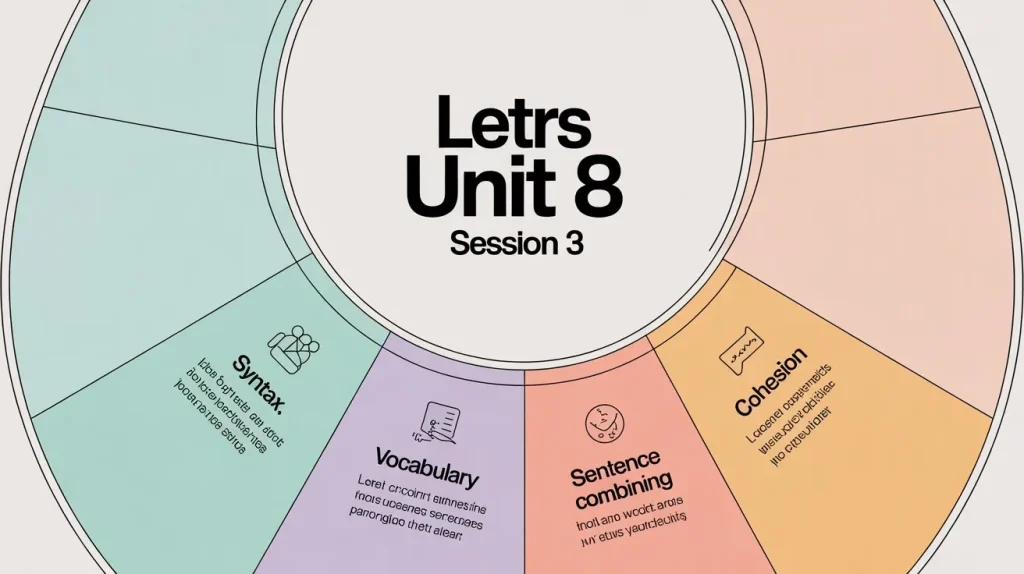
Understanding Vocabulary Instruction in LETRS Unit 8 Session 3
Which is a best practice for helping beginning writers learn and use different parts of speech in their writing?
Answer:
b. Provide students with question words (e.g., who, what, how) to connect with each part of speech.
Explanation:
Using question words helps students identify and understand the different parts of speech in sentences. It encourages them to think critically about their writing and enhances their ability to construct meaningful sentences. This strategy fosters a more engaging learning environment for beginning writers.
We have an expert-written solution to this problem! Which of the following statements is true?
Answer:
b. A compound sentence consists of two independent clauses linked by a coordinating conjunction.
Explanation:
This definition clarifies the structure of compound sentences, emphasizing the role of independent clauses and coordinating conjunctions. Understanding this concept is vital for writers to correctly form compound sentences and enrich their writing style. Recognizing this structure also aids in the comprehension of sentence variety.
Which is an example of a complex sentence?
Answer:
d. I have a dog that likes to bark.
Explanation:
This sentence illustrates a complex structure, containing an independent clause and a dependent clause. The dependent clause adds additional information about the dog, showcasing how complex sentences can elaborate on ideas. Learning to identify complex sentences is essential for developing advanced writing skills.
All of the following are coordinating conjunctions that students can use to form compound sentences EXCEPT:
after
Explanation:
Coordinating conjunctions typically include words like for, and, nor, but, or, yet, and so (FANBOYS). Understanding which words are coordinating conjunctions helps students construct proper compound sentences. Recognizing exceptions, like “after,” reinforces their grasp of sentence structures.
What is a simple way to explain the meaning of predicate?
Answer:
a. It is the action in a sentence (what the subject is doing, thinking, feeling, or being).
Explanation:
The predicate is a crucial component of a sentence that provides important details about the subject. This understanding simplifies the concept for students, allowing them to focus on what the subject is doing rather than getting lost in grammatical terminology. It aids in sentence construction and comprehension.
Also Visit:
| LETRS Unit 6 Session 6 |
| LETRS Unit 7 Session 1 |
| LETRS Unit 7 Session 2 |
| LETRS Unit 7 Session 3 |
| LETRS Unit 8 Session 4 |
| LETRS Unit 8 Session 5 |
| LETRS Unit 8 Session 6 |
LETRS Unit 8 Session 3: Using Diagnostic Assessments to Pinpoint Specific Reading Difficulties
Back when I was teaching, I remember a student who read beautifully out loud — smooth pacing, confident voice, not a hint of struggle. Every observer assumed she was a strong reader. But when it came to comprehension questions, she stared at the page like she had never seen the text in her life.
A general assessment never explained it.
A diagnostic assessment did.
That’s the heart of LETRS Unit 8 Session 3:
Diagnostics tell teachers why a student is struggling, not just that they are.
What LETRS Unit 8 Session 3 Actually Focuses On
This session explains how diagnostic assessments dig beneath the surface to identify specific reading skill weaknesses, including:
- phonemic awareness
- letter–sound knowledge
- decoding accuracy
- encoding/spelling weaknesses
- sight word recognition
- fluency components
- vocabulary understanding
- morphological awareness
- comprehension processes
Screeners say: “Something’s off.”
Diagnostics say: “Here’s exactly what.”
Why Diagnostic Assessments Matter
A student may fail at reading for dozens of different reasons.
If a teacher doesn’t know the exact cause, instruction becomes guesswork.
Diagnostics help teachers:
- uncover hidden foundational skill gaps
- avoid teaching the wrong skill
- match instruction to student need
- select the right intervention group
- prevent wasted time
- create precise instructional goals
The goal is clarity, not labels.
When Teachers Should Use Diagnostic Assessments
After a Screening Red Flag
If a student scores below benchmark on screening, diagnostics identify what the underlying issue is.
When a Student’s Progress Stalls
Even with good instruction, something deeper may be blocking growth.
When a Student’s Skills Don’t Add Up
Strong comprehension but weak decoding? Strong decoding but weak fluency? Diagnostics sort that out.
When Teachers Need to Plan Targeted Instruction
Grouping becomes far more accurate with diagnostic data.
Core Diagnostic Areas Explained in Session 3
1. Phonological and Phonemic Awareness
Diagnostics examine skills like:
- segmenting
- blending
- deleting sounds
- manipulating individual phonemes
Weaknesses here often hide beneath fluent speech.
2. Decoding and Word Recognition
These assessments reveal:
- specific phonics gaps
- incorrect mapping of sounds to letters
- difficulty with multisyllabic words
- overreliance on guessing
This is where many “mystery” reading problems emerge.
3. Fluency Components
Diagnostics break fluency into:
- accuracy
- rate
- prosody
Low fluency often traces back to inaccurate decoding — not speed.
4. Vocabulary and Morphology
Students may decode perfectly but lack:
- word meaning
- morphological knowledge
- academic vocabulary
This affects comprehension dramatically.
5. Comprehension Processes
Diagnostics uncover issues with:
- inference
- summarizing
- tracking ideas across text
- connections between paragraphs
The goal isn’t a score — it’s insight.
What Teachers Often Misinterpret (Session 3 Fixes This)
Confusing fast reading with strong reading
A fluent voice can easily hide decoding gaps.
Assuming comprehension weakness = comprehension problem
Sometimes the real problem is decoding or vocabulary.
Believing poor spelling is just “careless writing”
It is often a decoding or phonemic awareness issue.
Using a single test to judge a student
Session 3 reminds teachers to look across multiple data points.
Jumping straight to intervention without understanding the cause
Diagnosis comes first, instruction second.
How Teachers Use Diagnostic Data in Instruction
Step 1: Identify the exact weak skill
For example: “Student cannot segment phonemes.”
Step 2: Choose instruction that targets that skill
Instead of generic reading interventions.
Step 3: Set short, measurable goals
Clear, achievable steps keep students moving forward.
Step 4: Match students with the right intervention group
Grouping becomes accurate instead of random.
Step 5: Monitor progress more frequently
Diagnostics pinpoint, but progress monitoring checks growth.
Step 6: Adjust if the intervention isn’t working
Session 3 reinforces flexibility — not one-size-fits-all.
Classroom Example From Session 3
A second grader reads slowly and inaccurately, scoring below benchmark on screening.
A diagnostic assessment reveals:
- strong phonological awareness
- weak vowel pattern knowledge
- confusion with digraphs
- inconsistent decoding of multisyllabic words
This is not a “fluency problem.”
This is a phonics pattern problem.
After targeted instruction in vowel teams and syllable division, her fluency and comprehension rise naturally.
Without diagnostics, she would’ve been placed in a fluency group that wouldn’t help her.
What Growth Looks Like After Session 3
Teachers start to:
- diagnose rather than guess
- identify skill gaps quickly
- understand students’ reading profiles more clearly
- plan instruction smarter, not harder
- avoid mislabeling issues
- address root causes early
- support students with precision
And students begin to progress much faster because instruction finally matches their real needs.
Conclusion
LETRS Unit 8 Session 3 teaches teachers how to look beneath the surface of a student’s reading performance and identify the exact skill causing the struggle. Diagnostic assessments turn confusion into clarity, allowing teachers to deliver instruction that truly helps.
Instead of guessing or relying on surface-level scores, teachers gain the insight they need to intervene at the right moment with the right skill — and that’s what transforms student outcomes.
