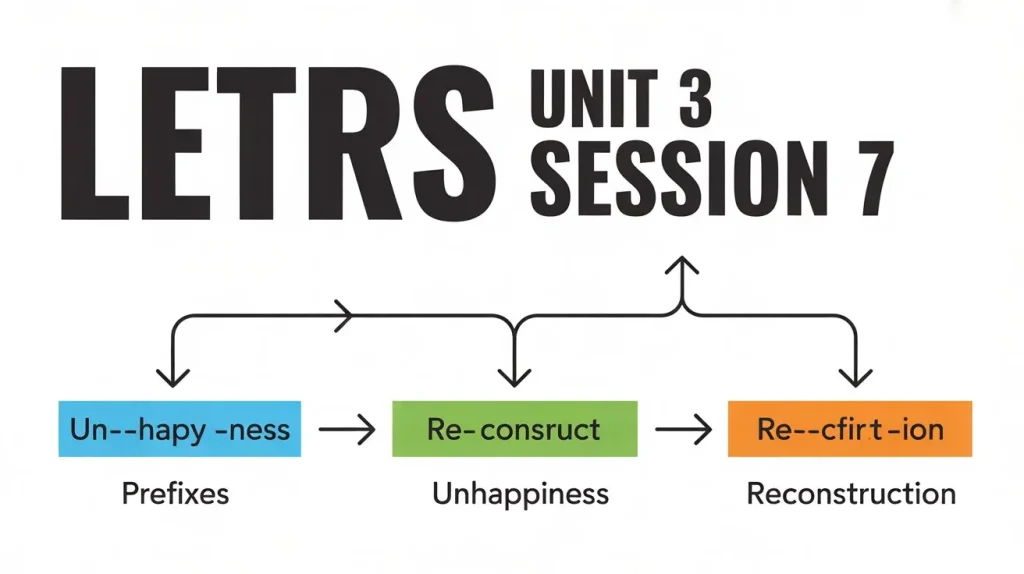
LETRS UNIT 3 SESSION 7 Check for Understanding
This session emphasizes essential techniques for monitoring comprehension and adjusting instruction accordingly. Learning how to check for understanding not only enhances student engagement but also empowers educators to tailor their teaching methods to meet diverse learning needs.
In this introduction to LETRS UNIT 3 SESSION 7 Check for Understanding, we will explore practical tools, strategies, and insights that can significantly improve the way teachers assess their students’ learning. By implementing these approaches, educators can foster a classroom environment where every student has the opportunity to thrive.
Understanding the Importance of Assessing Student Comprehension
Question?
Leveled texts are ranked on objective readability criteria, gradually becoming more difficult as students progress through the levels.
Answer:
false
Explanation:
Leveled texts are indeed assessed based on specific criteria for readability. However, the claim that they gradually become more difficult as students advance is not accurate, as leveling can vary among different text sets.
Question?
If a teacher follows a systematic process for transferring phonics skills to text, it’s reasonable to expect students to read a decodable passage independently after a week of instruction.
Answer:
true
Explanation:
When a teacher effectively implements a structured approach to teaching phonics, it sets a strong foundation for students. With consistent practice throughout a week, it is reasonable to expect students to achieve independence in reading decodable passages.
Question?
A school library has available a series of lavishly illustrated predictable texts written in verse. What is the most appropriate way to use these in the classroom?
a. Use them as teacher read-alouds to enhance oral language and comprehension skills.
b. Find predictable passages with at least one pattern word. Use these for the text-reading component of phonics lessons.
c. Read them to students repeatedly. When students have learned much of the text by heart, recite verses together.
d. Avoid using them. Young readers in a code-emphasis program should be exposed to decodable texts only.
a. Use them as teacher read-alouds to enhance oral language and comprehension skills.
Answer:
a. Use them as teacher read-alouds to enhance oral language and comprehension skills.
Explanation:
Utilizing illustrated predictable texts as read-alouds allows teachers to model fluent reading and enrich student vocabulary and comprehension. This strategy engages students and fosters a love for reading while providing valuable language exposure.
Question?
Students are reading a decodable text that uses only pattern words or high-frequency words students have been taught. What level of reading accuracy is reasonable to expect?
70%
80%
95%
100%
95%
Answer:
95%
Explanation:
Given that the text includes familiar pattern and high-frequency words, a reading accuracy of 95% is a reasonable expectation. This level of accuracy indicates that students can decode almost all of the text smoothly, which builds their confidence and fluency.
Question?
Over the course of a week of phonics instruction, which step in the Transfer to Text Process is the first that can be phased out?
a. Highlight skill words in a decodable passage.
b. Practice reading skill words in isolation before reading them in a passage.
c. Read a clean copy of a decodable passage.
d. Read the same decodable passage two days in a row.
b. Practice reading skill words in isolation before reading them in a passage.
Answer:
b. Practice reading skill words in isolation before reading them in a passage.
Explanation:
As students become more proficient with their phonics skills, the necessity for practicing skill words in isolation decreases. Transitioning to connected text allows for more authentic practice and reinforces their phonics learning in context.
PEOPLE ALSO VISIT:
| LETRS Unit 3 Session 1 |
| LETRS Unit 3 Session 2 |
| LETRS Unit 3 Session 3 |
| LETRS Unit 3 Session 4 |
| LETRS Unit 3 Session 5 |
| LETRS Unit 3 Session 6 |
LETRS Unit 3, Session 7: Empowering Readers Through Word Analysis
There’s a moment every reading teacher cherishes — when a student looks at a long, unfamiliar word and instead of panicking, they break it down, analyze it, and understand it.
That’s the essence of LETRS Unit 3, Session 7. This session emphasizes empowering students to use morphology strategically, making them independent, confident readers.
What This Session Covers
Session 7 focuses on advanced word study:
- Teaching students to analyze multisyllabic and complex words using prefixes, roots, and suffixes.
- Applying morphology to reading comprehension and vocabulary growth.
- Connecting word analysis to writing and spelling development.
- Encouraging students to approach new words with curiosity and strategy, not guesswork.
Dr. Louisa Moats stresses that teaching morphology is about giving students the mental tools to decode and comprehend any text independently.
A Classroom Story That Stays With Me
I had a student, Liam, who loved adventure stories but dreaded long words like antagonistic or circumference. He would freeze and often skip the word.
We dissected the words together:
- Anta–gon–istic → against + struggle + adjective
- Circum–fer–ence → around + carry + noun
He lit up, smiling, “I can actually read it now!” That day, Liam realized he could solve words logically, rather than memorizing them or guessing.
That’s the magic of Unit 3, Session 7: students stop seeing words as obstacles and start seeing them as puzzles they can solve.
Why This Session Matters
- Vocabulary grows rapidly: Morphology helps students understand hundreds of new words.
- Comprehension deepens: Understanding word parts improves sentence and paragraph meaning.
- Spelling becomes predictable: Recognizing patterns reduces guesswork.
- Confidence skyrockets: Students tackle challenging words with curiosity, not fear.
This session reinforces that morphology isn’t just about word knowledge — it’s about empowering students to navigate any text independently.
Practical Classroom Tips
- Encourage students to analyze unknown words before reading aloud.
- Integrate word analysis into writing exercises.
- Use games and activities to make word analysis interactive and fun.
- Celebrate every “aha!” moment when students decode a complex word independently.
Even short, consistent practice makes morphology feel like a superpower for students.
Reflection: Teaching With Heart
Watching Liam and other students decode and understand complex words is a daily reminder that literacy is more than reading; it’s about confidence, independence, and discovery.
Morphology gives students a lens to see words as meaningful, not intimidating. This session reminded me why teaching reading is both science and art — and why every “I got it!” moment is priceless.
